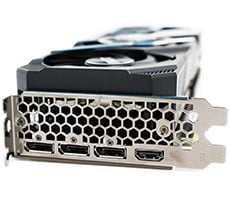
NVIDIA GeForce GTX 560 Debuts: ASUS and MSI

NVIDIA continues to flesh out their DirectX 11 GPU line-up, this time with a relatively affordable offering that drops in right between the GeForce GTX 560 Ti and GeForce GTX 550. The aptly named GeForce GTX 560 (sans Ti) launching today is essentially a replacement for the popular GeForce GTX 460 1GB. It’s outfitted with a similar number of CUDA cores, texture units, and ROPs, but the updated transistor mix in the GTX 560’s GPU allows NVIDIA to crank up the clocks, and thus increase performance.
NVIDIA is also taking a somewhat different approach with their board partners with this launch. We’re told that all retail boards will feature custom designs with varying overclocks. The “slowest” retail-ready GeForce GTX 560s will clock in at around 850MHz for its GPU, but some cards will exceed 900MHz. In fact, one of the cards we have on hand has its GPU clocked at 925MHz. You can see the specifications for the two cards we have in house below, along with some details regarding the GeForce GTX 560’s GPU configuration. There’s lot to get to, so let’s move on so we can get to the juicy stuff.
;)
Asus and MSI GeForce GTX 560 Cards
 |
|
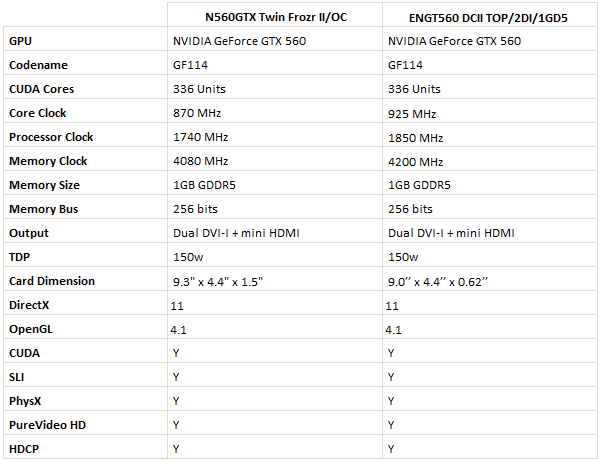
As we mentioned in our coverage of the GeForce GTX 560 Ti, the GF114 GPU at the heart of the GeForce GTX 560 is actually an update to the GF104 used on the GTX 460. As was the case with the GF110 on the GeForce GTX 580, which was essentially a reworked GF100, the new GF114 is a respin of the GF104. In terms of features, the GF114 remains unchanged, but NVIDIA worked with their foundry partner, TSMC, to respin the chip and implement a new transistor mix designed to reduce power consumption and increase yields. As a side benefit, the new GF114 is also capable of hitting higher clocks.
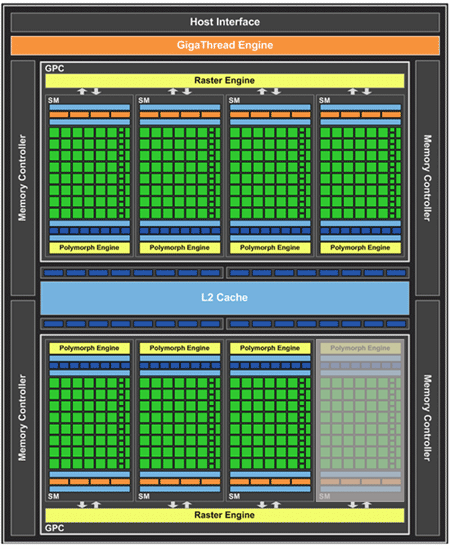
GeForce GTX 560 GPU Block Diagram
The GF114 is manufactured using TSMC's 40nm process node, and features roughly 1.95 billion transistors. When fully functional, the chip sports 2 graphics processing clusters, 8 streaming multiprocessors, 384 CUDA cores, 64 texture units, and 32 ROPs. It also sports a 256-bit memory interface, with support for GDDR5 memory, and a 512KB cache.
Each of the streaming multiprocessors in the GF114 GPU features 48 CUDA cores, 8 texture units, various registers and cache, and its own PolyMorph engine. On the GeForce GTX 560, however, one SM is disabled, which brings the total number of active CUDA cores down to 336 and the number of texture units down to 56. In short, the new GeForce GTX 560 is akin to a GeForce GTX 460, but with clock speeds more like a GeForce GTX 560 Ti.